Dioramas & Political
Assemblage
Striking Thirteen: Donald Trump Has Laid Waste our Times
February, 2026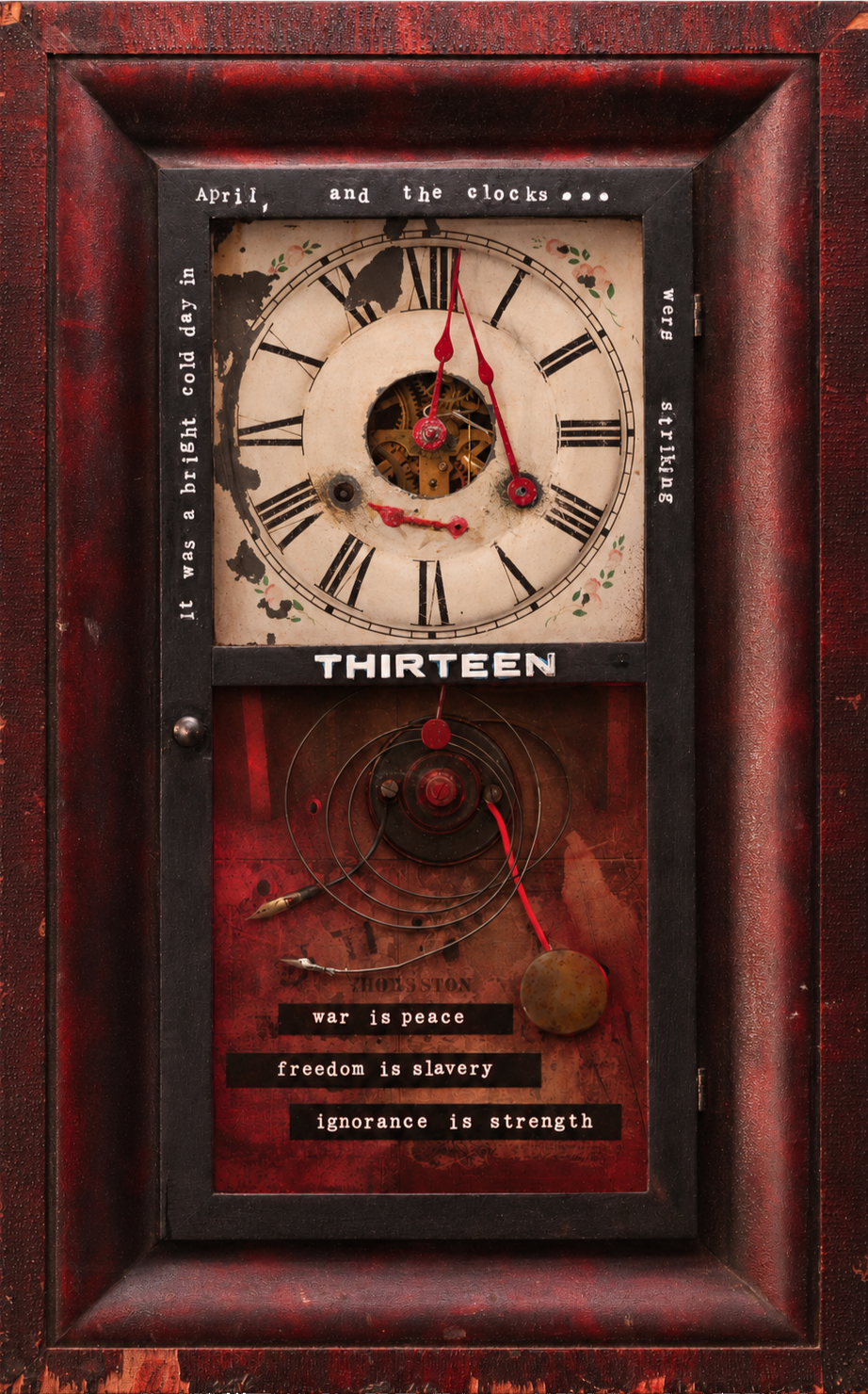
Seth Thomas clock, (1870s)

DESCRIPTION
Along the frame of the top window, I have stamped George Orwell’s opening line from 1984: “It was a bright cold April day, and the clocks were striking thirteen.” I replaced Roman Numeral XII with XIII, and added a third hand for extra measure to add confusion. All three hands are painted MAGA red. I attached a fountain-pen nib to a black wire, representing censorship and fake news, and another to the end of sprung gong coil.
A red “hot” wire replaces the pendulum rod. The pendulum itself is frozen to the right. I left the faded words on the cabinet panel alone, as if they were a worn-out Bill of Rights, over which I taped Orwell’s doublespeak: “War is peace,” “Freedom is slavery,” and “Ignorance is strength” as if from a redacted or censored document. The worm holes in the panel look like bullet-holes. The clock is lit from below by sinister MAGA red lights.
A friend offered me a Seth Thomas clock (circa 1870s) otherwise destined for the dump. I couldn’t resist those intricate brass gears and levers and flywheels, that Roman Numeral clock face, the weights, the bronze pendulum, the Cathedral gong coil and hammer all neatly housed in a cozy mahogany cabinet with two-paned windows.
Clearly, the clock had run out on this clock.
The hands dangled listlessly from the center spindle. The gears were jammed, the floral design flaked off and chipped, the pendulum and weights detached. I lifted and released the hammer onto the gong coil, expecting to hear a solemn, resonant chime. It sounded cartoonish. On the cabinet panel, the words “Warranted Good” and “Instructions for setting the clock running and keeping it in order” were just about rubbed out.
In its day, this clock took time seriously. It was reliable, but only if one paid attention. Every eight days, one was obliged to twist a clock key in one slot clockwise to set in motion a Rube Goldberg set of gears and weights carefully calibrated to keep the pendulum swinging and move the clock hands. Placed in another slot, the key must be twisted counter-clockwise to power the hammer to strike the gong on the hour.
I imagined that, if one lived alone and passed into the timeless beyond, the metronome of consistency would go silent, like a heartbroken pet without its caretaker.
This clock was mine now. I took it home, perched it on a chair and stared at it. It sat there for weeks, looking increasingly forlorn. I mused, had I taken time for granted? I wondered if it would be impertinent to take it apart and make something else, fashion some retro jewelry from the gears and the pendulum, or remove everything and work inside the hollow shadow box?
Then, while listening to Donald Trump’s latest vitriol and bigotry, I decided: if this clock could no longer measure time, it might take on a new purpose—to measure our times.
Under Trump, the past has been frozen into a sanitized and weaponized form of nostalgia in place of historical reckoning or collective memory. He has fetishized the fast food of crisis and paranoia. It’s the deep state, darker-skinned people, immigrants, aliens, barbarians at the gates. He has torn asunder time-honored mechanisms and institutions built to keep democracy ticking and provide balance, rhythm, and restraint. Every day, he smashes established norms, dismisses alliances formed over generations, and replaces continuity, deliberation, and accountability with loyalty and sycophancy. Dictators control time. Under Mussolini, his handlers claimed, the trains ran on time. They didn’t. His regime just said they did. Trump lies in real time, all the time.
Not a second to lose. I got to work. Now it looks like a cuckoo clock and a time bomb.
Sometimes art simply needs to be blunt, political, in your face. Time will not heal all wounds and I, for one, don’t have the patience. This clock will not see the landfill anytime soon. It reminds me to pay attention, to take the time to care for our times.
I hope it’s not too late.
______________
Morrison, T. (1996, March 25). The future of time: Literature and diminished expectations [Lecture]. 25th Jefferson Lecture in the Humanities. National Endowment for the Humanities, pg. 5. Retrieved from https://bit.ly/4r954CH
July, 2024
Serve the Chairman: Confessions of a Teenage Maoist
This is the story of how easily it is to get sucked in. As a teenager, I thought Chairman Mao was cool, avuncular….the Great Helmsman. I was insufferable, humorless, strident, impenetrable. This piece is my reminder of how dangerous it is to become an ideologue - right or left. It inspired me to write a bonus chapter for my new book, “In the Small Places: Teacher Changemakers and the Power of Human Agency.”
World’s Fair or Fair World?
July, 2023
My father performed in a “The Life of Booker T. Washington,” by Harlem’s Rose McClendon Players at the 1939-1940 World’s Fair. After a conversation with him when he turned 100, I imagine what his fellow thespians talked about then, and what has happened to America since. I created this diorama first, then decided to include it as the last chapter of my new book, “In the Small Places: Teacher Changemakers and the Power of Human Agency.”
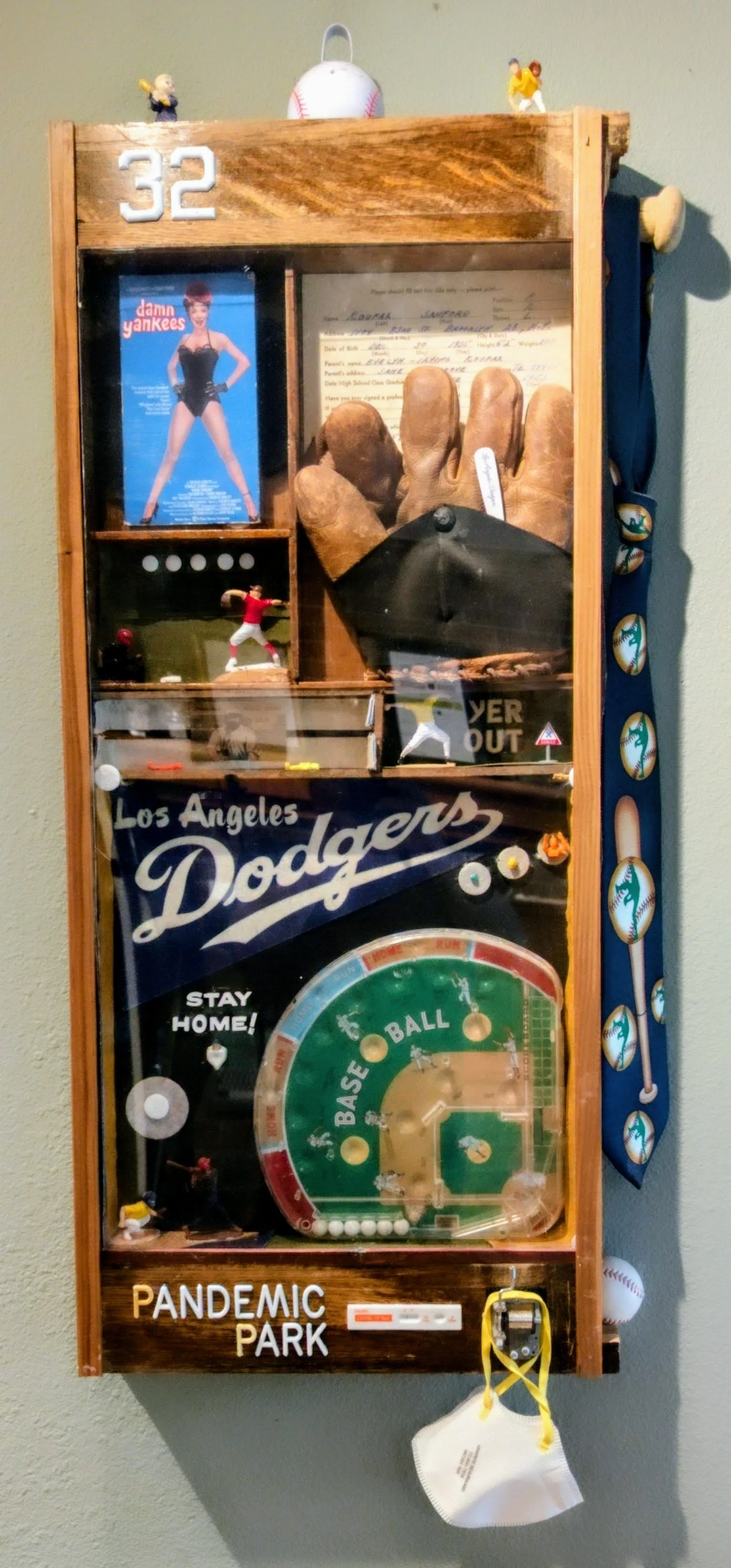
Pandemic Park
On hearing that the 2020 baseball season would not include live fans...
April 30, 2020
News broke that baseball season would be but a dugout shadow and cardboard cutout of its former self. Games without fans. Crowd noise piped in. No inappropriate cheers or managers kicking dirt on umpires’ shoes. No crying or hot-dog wrappers or peanut shells. I imagine semioticians out there feeling a little stir. What is real? What is fake?
Tired of reading, eating, sleeping, watching Sopranos reruns, and doomscrolling, I decided to clean the garage. I promptly stubbed my toe on what remained of an oak sideboard we had abandoned. The two side cabinets could no longer pivot smoothly on their hinges, and when we tried to close them, the legs would wobble. I saved the bottom drawer. I liked its tidy, deco-like sections for silverware and napkins. I turned it vertically…and voilá! I decided to build my own stadium.
I call it Pandemic Park.